Lions in Nairobi National Park
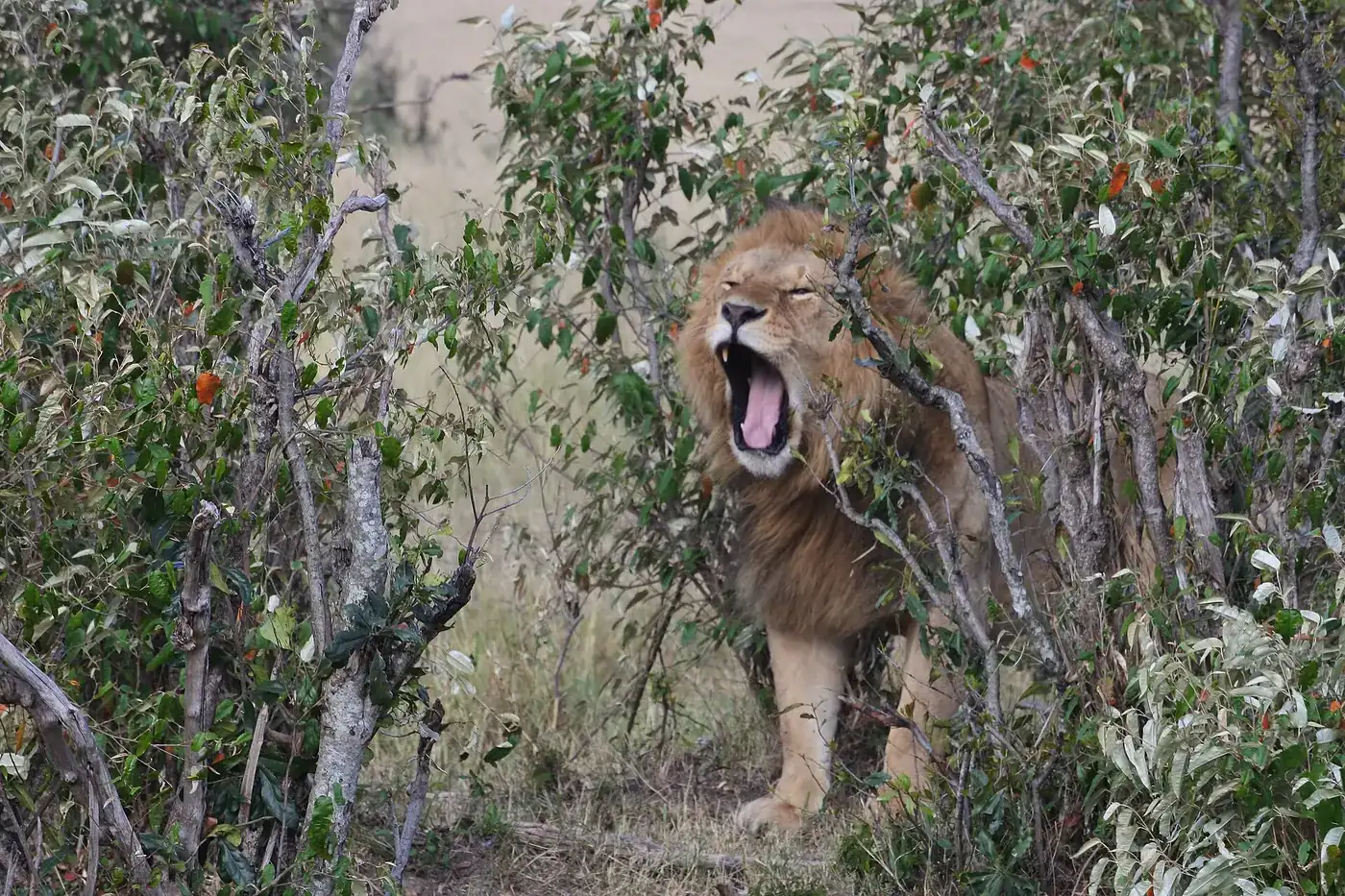
Yes. Nairobi National Park has wild, free-roaming lions. There are three prides in the park: Kingfisher, Athi and Mokoyet, and about 45 lions in 2019. Sightings are common on good mornings but never guaranteed, so start soon after the gates open at 06:00.
Lion facts at a glance
| Fact | Figure |
|---|---|
| Prides | 3: Kingfisher, Athi and Mokoyet |
| Population, 2019 estimate | About 45 lions, with 4 to 7 cubs |
| Population, 2018 survey | 34 to 43 lions, about 29 excluding cubs under one year |
| Population, early 2016 | About 36 lions: 3 mature males, 10 mature females, the rest juveniles and cubs |
| Population, 1970s | 30 to 35 lions in at least three prides |
| Park size | 117 square kilometres |
| Fence | About 73 km of electric fence on the city sides; the south is open to the Athi-Kapiti plains |
| Average home range | About 49 square kilometres (12 collared lions, 2014 to 2018) |
| Average daily distance | About 4.5 km a day; one male covered 29.9 km in a day |
| Subspecies | Panthera leo melanochaita |
How many lions, and the three prides
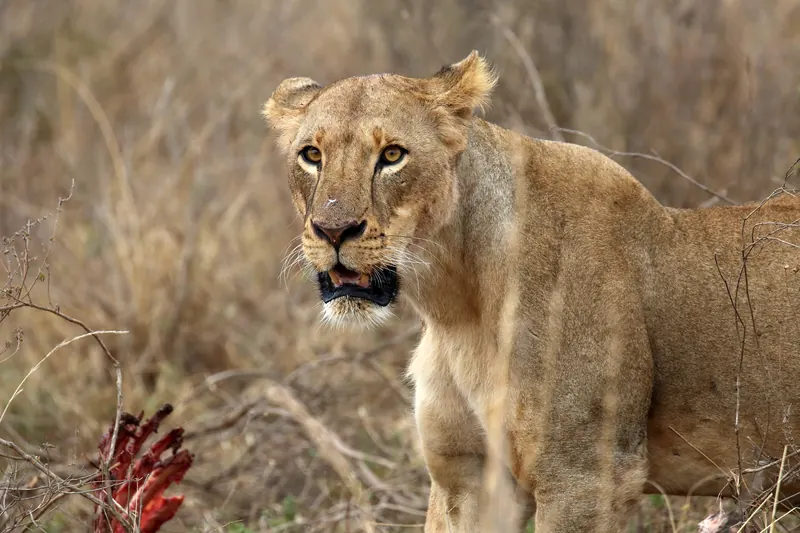
These are wild lions living inside the park, not animals in an enclosure. Kenya Wildlife Service says there are three prides, named Kingfisher, Athi and Mokoyet. The names follow park landmarks: Kingfisher and Mokoyiet are also the names of KWS picnic sites, and the Mokoyiet and Mbagathi are the park's two main rivers.
Counts move with births, deaths and lions leaving the park, so treat every number as a snapshot. There were about 36 lions in 2016 and 34 to 43 in three prides in 2018, when retaliatory killing outside the park was pushing numbers down. By 2019 there were about 45, including 4 to 7 cubs, and at least one coalition of nomadic young males.
Kenya as a whole has seen a steep fall: about 7,000 lions in 1990 and about 2,000 in 2007. That makes a breeding population on the edge of a capital city unusual and worth protecting.
Where to look for lions
GPS collar data from 12 lions showed that they prefer riverine woodland, then bushland and scattered tree grassland. Open grassland, the largest habitat in the park, was only slightly preferred, and lions avoided forest, open forest glades and whistling thorn shrubland. In practice, your guide works the edges of cover along drainage lines and river valleys, and checks open ground early, when a pride may still be out after a night's hunting.
The southern part of the park, along the Mbagathi river, is where lions most often cross out into community land, especially in the wet season. Lions inside the park stayed on average about 2.3 km from the fence. There is no fixed lion spot; your guide works from recent sightings.
Best time of day and season
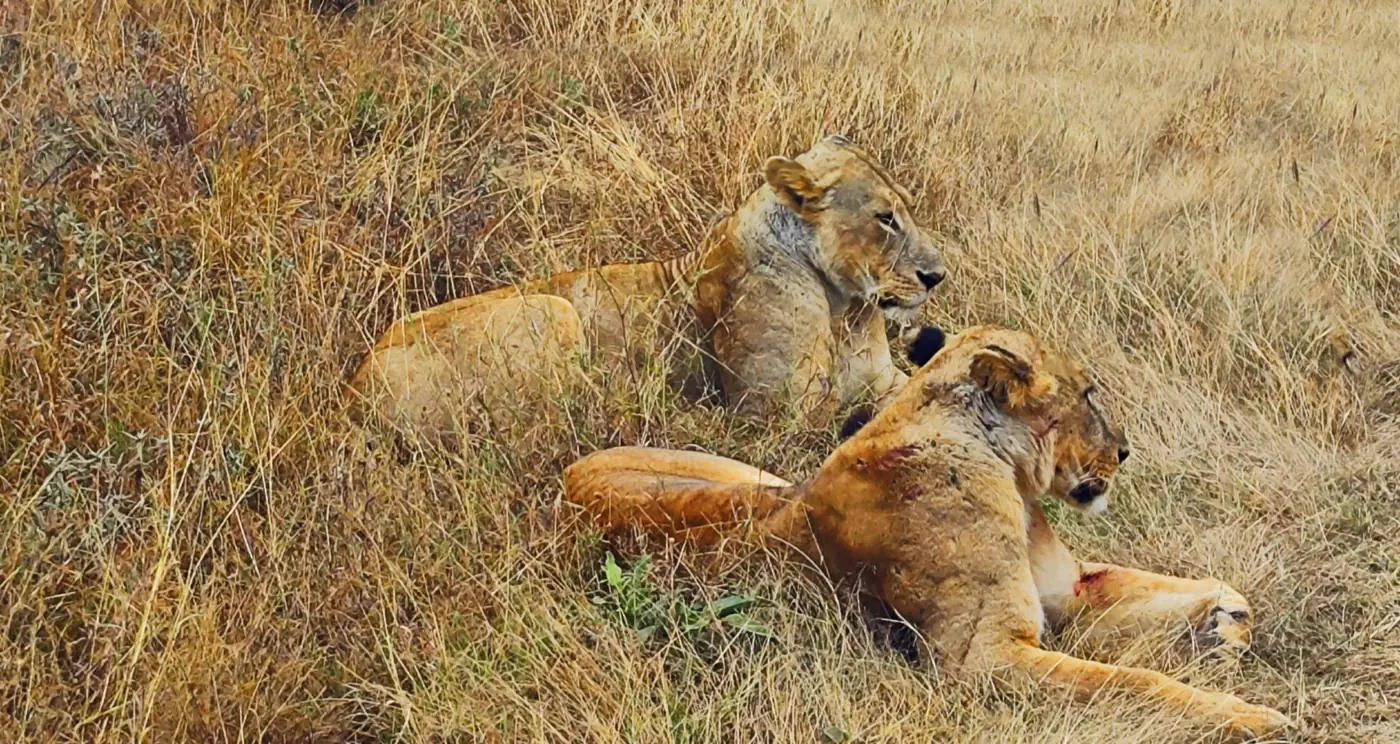
Early morning is the best time. The park opens at 06:00 and closes at 18:00 (see opening hours), and there is no visiting after dark on a day ticket. Research shows lions are most active when people are least active, at night, so the first hours after the gates open are your best overlap with them. By late morning most lions are resting in shade.
The long rains (March to May) and short rains (November to December) bring tall grass, which can hide a resting lion. Lions roam further into community land in the wet season. The dry months make spotting easier. Month-by-month advice is on the best time to visit.
How Nairobi lions behave
Like lions elsewhere, they rest for most of the day. Lionesses do most of the hunting and raise cubs together; pride males defend the territory. In Nairobi the ranges are small: the average annual home range of collared lions was about 49 square kilometres, with core areas of about 10. Males ranged further than females, and all three pride males were tracked crossing from the north of the park to the south in a single day.
Between 2014 and 2018 the collared lions made 864 trips out of the park into community land, lasting a median of 9 hours. Most went less than half a kilometre beyond the southern border, but some trips lasted more than five days.
History and conflict with the city
Nairobi National Park was gazetted in 1946 as Kenya's first national park. Lions were once heard near railway stations in what is now the city. Today the city is on three sides of the fence, and the open south is the lions' route to the Athi-Kapiti plains.
2016 showed what is at stake. In February, a group of lions left the park and were seen in Lang'ata and near Kibera before rangers returned them (NPR, Reuters). In March, a lion that had left the park attacked a man in Nairobi (BBC). In July, six lions, two adults and four cubs, were killed near Kitengela after attacking livestock (The World). National Geographic covered why lions were leaving the park.
KWS responded with fence maintenance and satellite collars, partly donated by IFAW, that alert problem animal teams when a collared lion heads towards people. The researchers recommend buffer zones in the south to keep a viable population and reduce conflict.
Watching lions responsibly
- Stay on the road. Off-road driving is not allowed under the park rules.
- Keep quiet, stay seated and keep arms inside the vehicle. No calling, tapping or playing sounds to get a lion to look up.
- Give space, especially to lionesses with cubs or lions on a kill. Do not block a lion's path to water or cover.
- Share the sighting: limit your time when other vehicles are waiting.
- No feeding and no baiting. Never get out of the vehicle outside designated sites.
Photographing lions
Morning light is soft and lions are more active, so it is also the photographer's best window. A lens of about 100 to 400 mm covers most sightings from the road; a phone works for close lions. Use a bean bag on the window or roof rather than a tripod, and ask the guide to switch off the engine to stop vibration. The shot most visitors want is a lion with Nairobi's skyline; it needs the lion, the light and the angle on the same morning. A photography safari gives longer stops and the roof open.
Your chances on a half-day vs a full-day drive
A half-day private game drive gives roughly 3 to 4 hours in the park. A full-day private safari gives the guide time to check more areas and come back to places where lions were seen earlier. If lions are the main reason for your trip, choose a full day or a morning start, and tell us when you book.
Wild lions vs the Safari Walk and Animal Orphanage
The Nairobi Safari Walk and Animal Orphanage beside the Main Gate are KWS sanctuaries with animals in enclosures. They are not the wild park. Prices are on Safari Walk entry fees.
Book a drive to look for lions
Look for lions on a half-day private game drive at $300 per group (your group only, park fees paid separately), or the weekend Land Cruiser drive at KSh 4,500 resident or $55 non-resident. Park fees are paid separately to KWS.
Quick answers
Are there lions in Nairobi National Park?
Yes. The park has wild, free-roaming lions in three prides named by KWS: Kingfisher, Athi and Mokoyet. Sightings are common on good mornings but never guaranteed.
How many lions are in Nairobi National Park?
About 45 lions in 2019, including 4 to 7 cubs, up from 34 to 43 in 2018. Numbers change from year to year.
What is the best time to see lions in Nairobi National Park?
Early morning, soon after the gates open at 06:00, before lions move into shade. The dry months, when the grass is short, also help.
Will I see a lion on a half-day drive?
You may, especially on a morning drive, but it is not guaranteed. A full day gives more time to search.
Do lions leave Nairobi National Park?
Yes. The south of the park is unfenced, and collared lions made hundreds of short trips into community land between 2014 and 2018, mostly at night and in the wet season.
Is it safe to see lions in Nairobi National Park?
Yes, from the vehicle. Stay seated, keep arms inside, keep quiet and follow the guide. Leave the vehicle only at designated sites.
Are the lions in Nairobi National Park wild?
Yes. The lions in the national park are wild. The Safari Walk and Animal Orphanage beside the Main Gate are separate KWS sanctuaries with enclosures.
More animal guides: zebras, buffalo, hippos and birds, with where and when each is usually seen.
Related pages
Book this safari
Send the date, the group, and the pickup. We confirm availability on WhatsApp or email, with the tour price and the park fees to budget. See our deposit and cancellation policy.